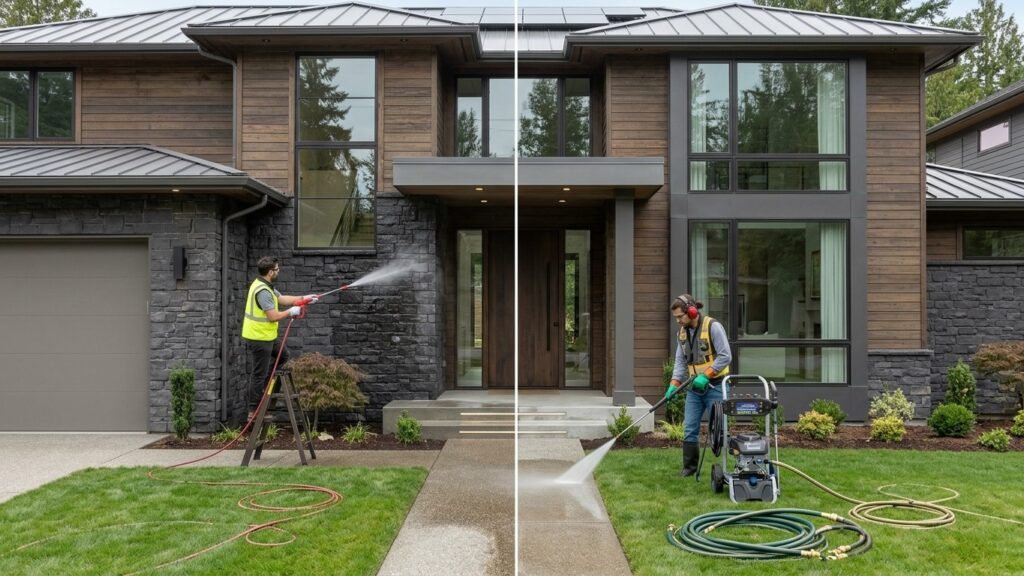
When homeowners search for exterior cleaning, they often see two terms: pressure washing and soft washing.
Although both methods are used to clean exterior surfaces, they are not interchangeable.
The main difference is the cleaning approach and the type of surface being cleaned.
Pressure washing is commonly used for harder surfaces such as concrete, sidewalks, patios, and driveways. Soft washing is often used for more delicate surfaces such as siding and roofs.
Using the appropriate method can help clean the surface effectively while reducing the risk of unnecessary damage.
What Is Pressure Washing?
Pressure washing uses pressurized water to remove dirt, grime, stains, mud, and other buildup from surfaces.
It is especially useful for hard, durable surfaces.
Common pressure-washing applications include:
- Concrete driveways
- Sidewalks
- Patios
- Concrete surfaces
- Some decks
- Hard outdoor surfaces
- Commercial exterior areas
Over time, concrete can become discolored by dirt, algae, mud, vehicle traffic, and weather. Professional pressure washing can help restore a cleaner appearance.
What Is Soft Washing?
Soft washing is a lower-pressure exterior cleaning method designed for surfaces that may be damaged by excessive water pressure.
It can be used for surfaces such as:
- House siding
- Certain roof surfaces
- Stucco
- Painted exterior surfaces
- Other delicate materials
Rather than relying primarily on high water pressure, soft washing uses an appropriate cleaning solution and controlled rinsing process.
Why You Shouldn’t Use High Pressure Everywhere
It may seem logical that more pressure means better cleaning. That’s not necessarily true.
Some exterior materials can be damaged by excessive pressure. For example, aggressive cleaning can potentially affect paint, siding, wood, seals, or other components.
The objective of professional exterior cleaning should be effective cleaning appropriate to the material, not simply maximum pressure.
Which Method Is Better for House Siding?
For many types of residential siding, soft washing can be a suitable approach.
House siding can collect dirt, pollen, algae, mold, mildew, cobwebs, and environmental grime.
Professional house washing should use an approach appropriate for the siding material and condition.
Which Method Is Better for a Roof?
Roof cleaning requires particular care.
A roof is not the same as a concrete driveway. High-pressure cleaning may not be appropriate for many roofing materials.
A professional should evaluate the roof material, condition, access, and type of buildup before selecting a cleaning method.
What About Concrete?
Concrete is generally much more durable than siding or roofing materials.
Driveways, sidewalks, and patios can accumulate dirt, mud, algae, tire marks, organic debris, and general weather-related stains.
Pressure washing can be an effective method for cleaning these hard surfaces.
What About Decks and Fences?
Decks and fences require consideration of the material and condition.
Wood surfaces can be more sensitive than concrete, especially when they are older or already weathered.
The cleaning method should therefore be selected based on the material rather than applying the same pressure used on a driveway.
Soft Washing and Pressure Washing Can Work Together
Choosing between soft washing and pressure washing isn’t always an either-or decision.
A property can contain many different surfaces. For example, a homeowner may need:
- Soft washing for siding
- Roof soft washing
- Pressure washing for a driveway
- Cleaning for sidewalks
- Patio cleaning
- Deck cleaning
- Fence cleaning
A professional exterior cleaning company can evaluate each surface and determine an appropriate cleaning approach.
How Often Should You Clean Your Home?
Cleaning frequency depends on the property’s environment and condition.
Homes surrounded by trees, exposed to moisture, or located in areas where organic growth develops quickly may require more frequent cleaning.
A homeowner should also pay attention to visible signs of buildup instead of relying exclusively on a calendar.
Common Exterior Cleaning Mistakes
Mistake #1: Using the Highest Pressure Possible
More pressure isn’t automatically better.
Mistake #2: Treating Every Surface the Same
Concrete and siding have very different cleaning requirements.
Mistake #3: Ignoring Organic Growth
Algae, mold, and mildew can make an exterior look neglected.
Mistake #4: Forgetting the Surrounding Property
Landscaping, windows, doors, outdoor furniture, and other nearby items should be considered during an exterior cleaning project.
Why Choose a Professional Exterior Cleaning Company?
Professional exterior cleaning involves more than spraying water.
The right approach involves understanding:
- Surface materials
- Appropriate pressure
- Cleaning solutions
- Equipment
- Safety
- Property protection
- Access requirements
Old Fireman’s Services is firefighter-owned and operated and has more than 31 years of fire-service experience. The company provides pressure washing and soft washing for residential and commercial properties.
Professional Soft Washing and Pressure Washing
If your home has dirty siding, a stained driveway, an algae-covered patio, or other exterior buildup, the first step is determining what type of cleaning the surface needs.
Old Fireman’s Services provides professional pressure washing and soft washing throughout Northern Virginia, Maryland, the Eastern Panhandle of West Virginia, Southern Pennsylvania, and surrounding areas.
Call or text (571) 271-8532 to request a free estimate.